



Source: https://delphis.org.uk/peak-performance/stress-and-the-pressure-performance-curve/
If you have a job, you make an average of 35 decisions at work every day.
That number doubles to 70 if you’re a leader.
No matter what role you currently have, I’ve got two questions for you…
- How many decisions do you make with everything you need, right at your fingertips, all the time?
- And how many decisions are you making when you feel scattered, distracted, and under pressure?
Most professionals are guessing their way through the day, one decision at a time.
And that’s a costly problem—for reasons most people never stop to consider.
Some of these costs include (but are not limited to)…
- Rework
- Missed deadlines
- Errors that slip through
- Damaged trust
- Team drag
- Burnout
- Lost revenue
Do any of these hit home for you?
If so, here’s the truth:
None of this happens because you’re not capable of doing the work and doing it right.
It’s not because you’ve been careless or that you lack smarts or discipline. Or an assistant.
There’s no need for a better to-do list or a better email app to help you. (…and btw, tech is never the answer.)
And it’s not that you haven’t put in enough time or tried hard enough.
The problem is structural.
It’s the behind-the-scenes management of the work itself.
I talked about this concept in Issue #001 of the Efficiency Edge. It’s called “the work behind the work.”
And “the work” is ALL about task management. (Even EMAIL is task management in disguise.)
How you manage your tasks is paramount.
But your processes today are likely pushing you backwards or keeping you stuck more than you know.
So, let’s talk about this…
Your Workday is Harder Than It Should Be Right Now
Professionals regularly share their workday wishes with me and ask me questions about how to achieve them.
Here are just a few…
- “I wish I was better at systems like tracking things.”
- “How can I stay on top of things when there are so many plates spinning and platforms, media, organizational tools, and people all competing for my attention, time, and energy?”
- I’d love to know how to protect and manage energy during the workday—especially in environments where constant notifications, meetings, and shifting priorities drain focus.
- “How can leaders can manage competing priorities without feeling like they’re constantly reacting to the next urgent task? Between work, family, and personal goals, maintaining focus and protecting our energy has become increasingly important.”
- “I’d like a better task/to do list. I feel like I sit down in the office and I’m like, where do I even start?!”
- “How do I decide what to focus on first and stay productive without feeling overwhelmed?”
People tell me again and again that they’re losing time and energy every day. Not from doing the work, but from managing the chaos around the work.
And if managing “the work behind the work” is draining YOU of much-needed time and energy, it’s robbing you of truly being effective and productive. And that is robbing you of progress and results, as well as personal time.
But it does something else, too…
It’s crippling your ability to make great decisions. Let’s look at why…
“Task Scatter” is Affecting Decisions That Matter
Tasks are coming from everywhere.
Notes, papers, files, and other information dwell in a dozen different places.
Email lands in one place, yes, but the issue becomes managing them from there.
(And spoiler alert: you can’t manage any of them effectively while they’re still sitting in the Inbox.)
And the countless tools professionals have to use these days is mind numbing.
All of this causes strain on your brain as it tries to keep up and hold it all together… in real time… all day long.
And this causes you a lot of stress when trying to get things done.
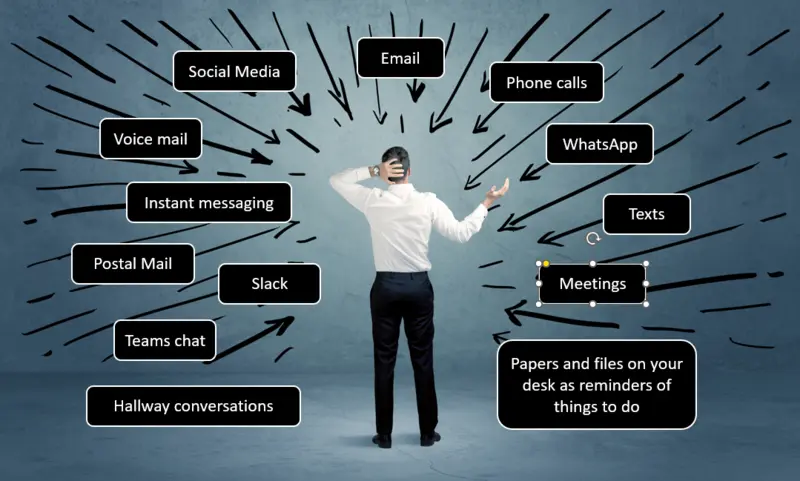
When tasks are scattered everywhere, you can’t see them all, and therefore, they’re impossible to prioritize.
When you can’t prioritize accurately, it’s impossible to plan action with any confidence. You know you don’t have a complete picture.
And when you don’t have a complete picture of all of your tasks and responsibilities, it’s impossible to execute without the nagging feeling that something, somewhere, has been missed.
Frustrating, right?
This is one of the leading causes of anxiety and worry at work.
You can’t make smart DECISIONS about what to do next and how to spend your precious time when you can’t see everything you need to manage.
You’re working harder than ever, but you feel like you take two steps forward and one step back most of the time.
But you DO need to see everything in once place. It’s what makes great decisions possible. More on this in a minute. But first…
Why It’s Impossible to Make Great Decisions Consistently
Let’s be specific about why decision-making breaks down, because it’s not just one thing. It’s five things, stacked on top of each other:
1/ Tasks, emails, and information are everywhere. Multiple sources of tasks, as mentioned earlier, cause only half the challenge. The other half is caused by all of the TOOLS people grab for to stay afloat: notebooks, legal pads, planners, whiteboards, sticky notes, apps, spreadsheets, word documents, and your memory, just to name a few. And none of these talk to each other. As tech evolved and expanded over the years, you’ve also inherited more apps and platforms you didn’t ask for, each one bringing more tasks, making it even harder to keep track of them.
2/ Awareness is down. If you’re not aware of certain tasks—or you were aware, but now they’ve slipped your mind—you can’t prioritize, protect time, or execute quickly on what needs to be done. You’re missing clarity.
3/ You’re under extreme pressure to get things done. You have a long list of things to do. Some tasks have deadlines, many don’t. Goals are numerous. Expectations are high. And people, projects, and teams are waiting on you to get things done. And unfortunately, you’re working in a workday with no real structure or boundaries anymore.
4)/ You’re highly distracted. Notifications, messages, and interruptions are relentless. These are the never-ending “rings, dings, and pings” in your workday. But even without all of the digital interruptions, you still have to deal with self-inflicted distractions, causing you to be reactive. Like when something on your desk catches the corner of your eye, you go down a new path, because you suddenly remember something formerly forgotten.
5/ You have so little time. Time is precious to begin with, but the processes you’re using in your workday to keep up with tasks, email, and information are holding you back. Some are broken, some are missing, and time and energy are lost because of this.
Individually, each of these is a real challenge. Together, they form a trap that’s hard to escape.
With time at a premium, you wonder, “How can I stop what I’m doing to figure out how to fix all of this?”
And here’s what almost no one talks about: this combination doesn’t just make your day harder.
It actively damages the quality of the decisions you’re making, all day long.
Three issues arise with regard to this. Let me explain…
Issue #1: More Pressure = More Bad Decisions
Most people assume that stress and pressure can sharpen focus. “I do my best work under a deadline!”
Sound familiar?
But research says otherwise.
A study by Walden University showed that when stress and anxiety aren’t balanced or managed well, our bodies shift into a negative stress state (and that’s toxic stress), “…causing a decrease in blood flow and oxygen to the brain, which promotes lower cognitive functioning and sends the brain into a chaotic state.”
Decisions fail under pressure because our prefrontal cortex shuts down.
High cortisol and adrenaline turn off rational thinking and our brain is unable to access the information it needs to make logical decisions and reason clearly. Combine strict deadlines with high pressure and decision quality sharply drops.
These are the exact conditions most professionals are living with every day. Not calm, cool, collected workdays, but a chaotic, stressful workdays with a clock running.
Research has consistently shown that decision-making abilities under time constraints are compromised: “…associated stress can lead to perceptual narrowing, resulting in reduced vigilance, working memory capacity, and the utilisation of available information.”
(Accuracy-Time Tradeoffs in AI-Assisted Decision Making under Time Pressure)
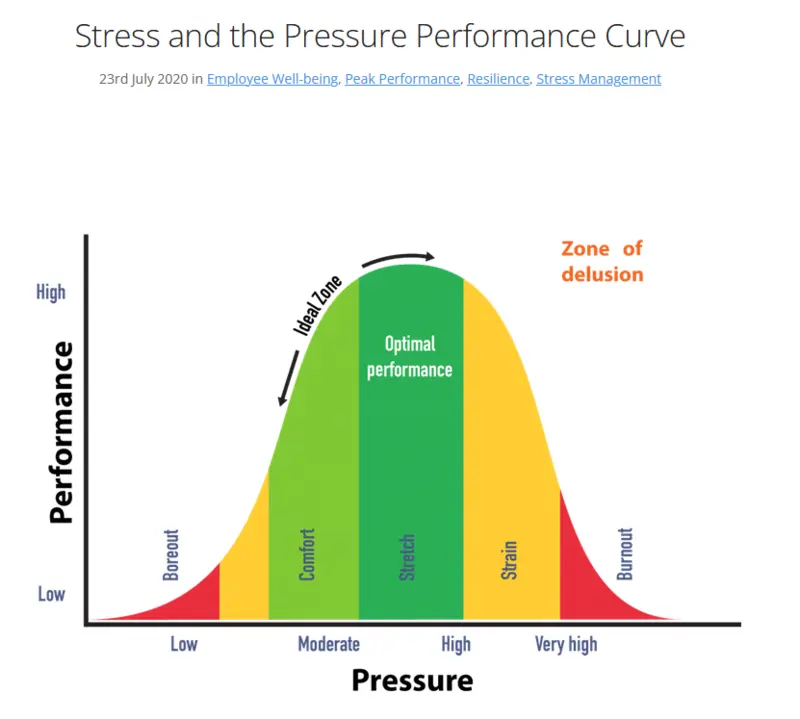
Source: https://delphis.org.uk/peak-performance/stress-and-the-pressure-performance-curve/
When stress persists, a negative cycle continues…
The more decisions you have to make in a day, the more stressed, distracted, and reactive you become.
Performance drops when pressure gets too high and you’ll be less effective at any given task you undertake.
And you may even stop making new decisions altogether.
One study found that participants preparing for a medical exam under sustained stress tended to default to habitual decisions instead of decisions suited to the situation they were facing. According to the study, “…the brain resorts to habitual decision making because it exerts less demands on our cognitive resources.”
In other words, when you’re under pressure, your brain doesn’t rise to the occasion. It falls back on familiar habits, which is the easiest way out.
That’s not a character flaw. That’s biology.
This is exactly why, when your day changes and priorities shift, it’s such a challenge to pivot quickly. I get that question all the time…
“What do I do when my day changes and it derails my original plan?”
The answer is that you must be able to override your tendency to get stuck with your original decisions in order to adapt to the changes happening around you.
And there’s only one way to do that. I’ll get to that in a minute.
But when your entire day is fueled by pressure—because tasks are everywhere, nothing is prioritized, and everything feels urgent—you are, by design, making your worst decisions during the moments that matter the most.
Issue #2: A Distracted Brain Can’t Make Good Decisions
Now stack distractions on top of stress and pressure.
You already know distractions and interruptions cost time. But most people underestimate by how much.
Research from Dr. Gloria Mark at the University of California, Irvine—one of the most cited names in this field—found it takes an average of 23 minutes and 15 seconds to fully regain deep focus after a single interruption.
This quote from the article is jaw-dropping:
“A company that has 55 employees with an average salary of $50,000 annually, will pay $1,065,900 per year for lost productivity due to distraction. And this is a conservative estimate that only considers the direct costs of distractions.”
Source: https://www.maurathomas.com/manage-distraction-costs-millions/
Now consider how often you’re interrupted or distracted at work.
Some research says every few minutes.
If you do the math, you’ll see that if it takes 23 minutes to recover, but a new interruption lands before that recovery is complete, your brain never fully completes a single thought throughout the day.
Complete and total focus becomes mathematically impossible.
When you’re highly distracted on top of time pressures, your brain doesn’t just work slower. It works with LESS of the information it has, even when that information is right in front of you.
And that’s not a recipe for making great decisions. That’s a recipe for making guesses.
Issue #3: Great Decisions Rely on Great Data—But Not Too Little and Not Too Much
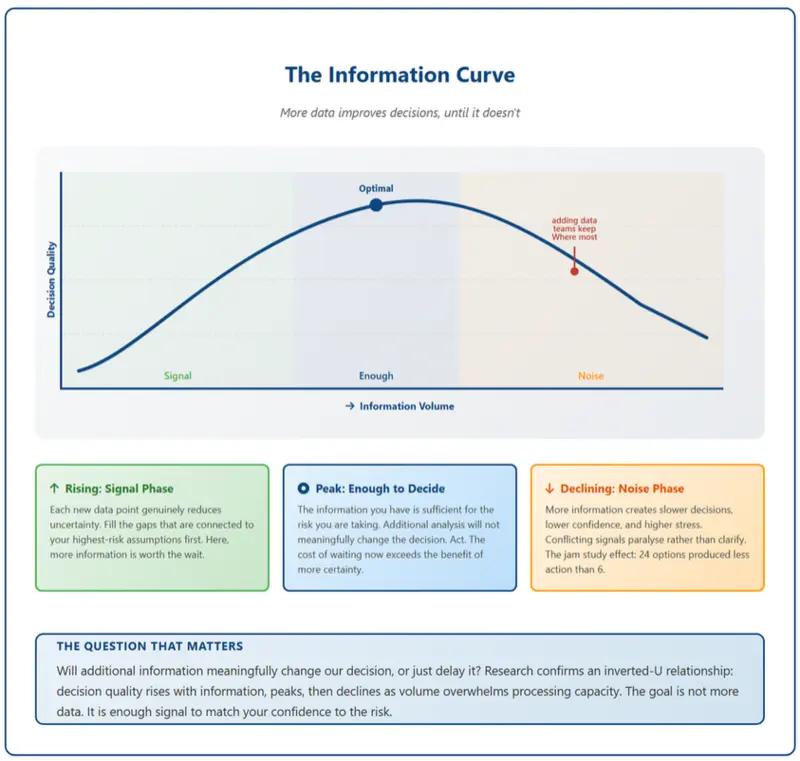
There’s a well-established concept in decision research called the information overload curve. As relevant information increases, decision quality improves… up to a point.
Past a certain point, decision performance declines as the brain becomes overloaded and overwhelmed.
Source: https://www.turningdataintowisdom.com/stop-waiting-for-certainty-start-managing-decision-confidence/
But here’s the thing…
We all know that too much information can be overwhelming and time-consuming to review, but having too little information is far more concerning when you need to make decisions.
Similar to “task scatter,” this is “information scatter.”
Leaders and teams struggle to make timely, effective decisions when it’s fragmented across systems, buried in email, or missing entirely from view.
McKinsey research found that employees spend, on average, 1.8 hours every day—9.3 hours a week ,just searching for and gathering information they need to do their jobs.
Other research from IDC puts it even higher: roughly 2.5 hours a day, nearly 30% of the entire workday, spent searching rather than doing.
And an article by LumApps shares another key point worth noting…
“Teams using fragmented communication systems report a 25% drop in decision-making confidence when dealing with data from various sources. Meanwhile, organizations lose an estimated $62 million annually due to poor information management.”
All of these points affect decision making, because the more time you spend looking for data, the less time you have to review and assess the data, and make smart decisions as you work.
Let’s return to that 30% figure that represents lost time when looking for things you already have.
Now put yourself in the middle of that search. You’re under pressure. You’re getting interruptions. And you’re being asked to decide—prioritize this task, respond to that email, answer that question, commit to that deadline—without the information you need to make the decision with confidence.
Instead, you default to the easiest option or worse, you freeze up… stuck in analysis paralysis, unable to move forward because you know you’re missing something… but what?
Either way, the decision you make is compromised before you even make it.
This is why so many capable, hardworking professionals feel like they’re constantly making poor decisions. You make one decision today and pay for it later.
Sound familiar?
If so, just know…
Your level of your productivity each day is never about capability.
It’s about the conditions under which you’re making decisions.
And here’s the most important part …
You can’t think, will, or hustle your way out of these conditions.
You can’t out-discipline or out-work a structural problem.
It’s time to build the foundation that will support you and create better conditions for making better decisions in your workday.
What Makes Smart Decisions Possible
The remedy isn’t found in a new app. It isn’t “just focus harder” or “work more hours.”
To get a grip on everything coming at you and make sure and steady progress every day, you need to be able to see your tasks ALL in one place.
And that means >>> One system.
If you don’t have a single system to manage your work, you’re operating in a workday without a foundation.
But that foundation can be formed.
You can fortify your workday with a system that supports you and your work, seamlessly and effortlessly, so you can make new decisions and change directions quickly when you need to—without missing, losing, or forgetting anything.
A complete system will bring tasks, email, information, and time management strategies together into a single, connected structure.
Only then can you finally see everything you’re responsible for in ONE place and be able to make smart decisions about how to spend your time.
One system allows you to easily gather tasks, prioritize them accurately, and not only plan action, but take action all throughout the day, readily and steadily.
When that happens, something meaningful shifts.
You don’t have to decide what to do next from a scattered, partial view of your work.
You can decide with clarity and confidence from the whole picture…
Every task, regardless of where it came from or when you’re going to do it…
Every commitment sitting in your email Inbox…
Every piece of information you need, right when you need it.
This is possible with The 4 Process Pillars™ I talked about in Issue #2 of The Efficiency Edge. They support your entire workday: Task Management, Time Management, Email Management, and Information Management.
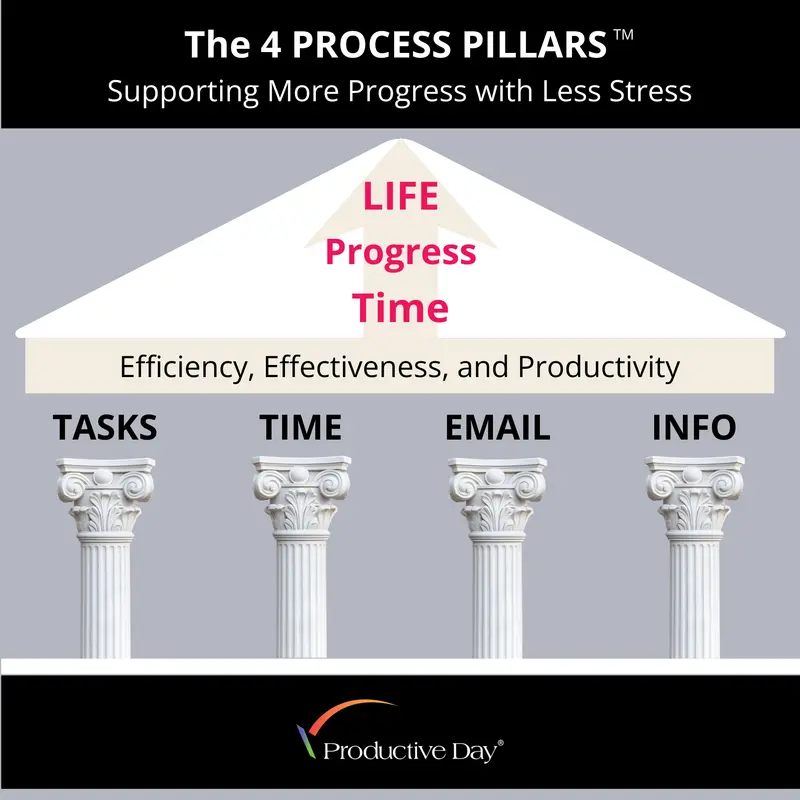
When just ONE of these is broken—or worse, missing entirely—the other three are compromised.
These are not separate processes—or problems—to solve one at a time when they’re not working.
They all belong in ONE connected system, working together to give you the highest levels of efficiency and productivity, plus steady progress and tangible results.
Plus, a single system gives you back TIME, which reduces stress and pressure.
You can regain time you’ve been losing to searching, re-checking, re-explaining, and recovering from interruptions.
Time you can reinvest into doing the work you were actually hired to do—the work you love to do!—instead of managing the work behind the work.
The bottom line: Optimal workload management will improve the quality of every decision you make.
And that’s how you gain what I call The Workday Advantage™.
For now, I’ll leave you with this question…
Of the five conditions working against you right now—scattered tasks/email/information, low awareness, pressure, interruptions/distractions, or too little time—which one is hitting you the hardest?
I read and respond to every email. Let me know.
Until next time…
Remember to make the most of your minutes.
Protect time for what matters.
And make memories you’ll cherish.
Greater productivity doesn’t mean packing MORE work into your workday.
It’s about getting work done from start to finish, faster and easier, so you can have more time to enjoy life.
Leslie
P.S. If you’re tired of feeling fed up, frustrated, and feel like you’re falling behind instead of getting ahead and enjoying time in your life, check out my proprietary system, Taskology® The Science of Getting Things Done. It’s a time-tested, proven system that’s been getting results for our clients for 23 years.
Visit productiveday.com for more information and be sure to take advantage of our Free Resources, too. Check it out today and get started on having an easier, more efficient workday and a life with less stress.