




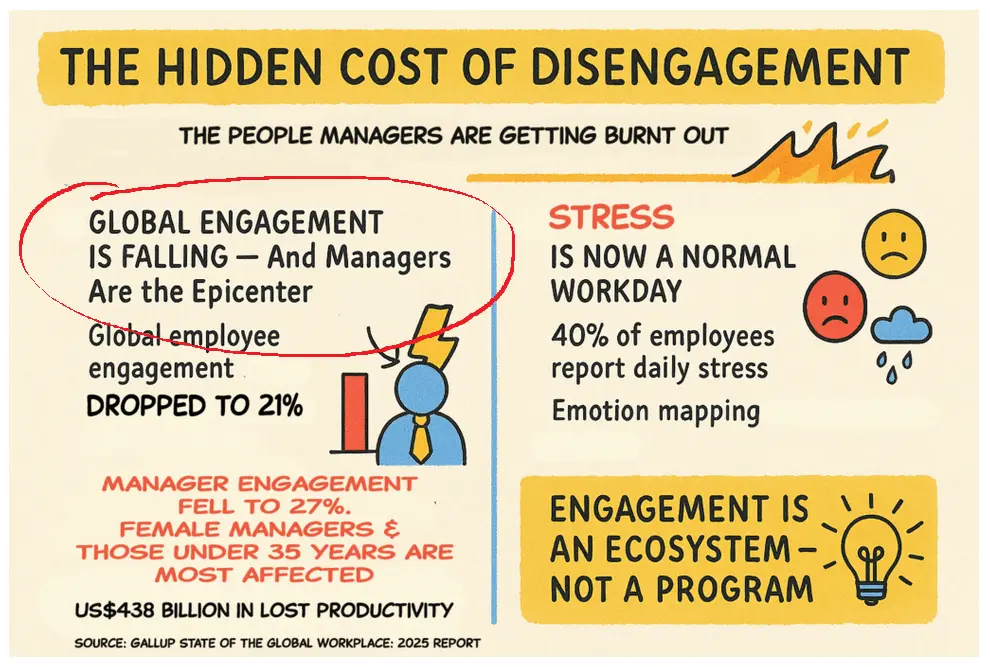
As it turns out, organizations are unknowingly sabotaging their own success.
Not because they have poor strategies or lack talented employees.
But because they’re creating conditions that prevent good managers from succeeding.
It’s a much bigger problem than most organizations—and their executive teams—realize.
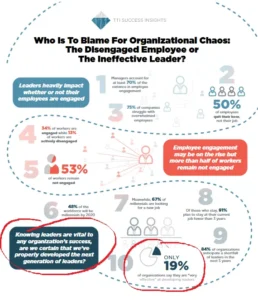
Gallup reports that managers account for approximately 70% of team engagement in their companies.
Think about that for a moment.
If managers influence the daily experience of every 7 out of 10 employees, organizations should be investing far more in helping their managers succeed.
Sure, organizations spend enormous amounts of money every year training managers on topics like…
Leadership
Communication
Emotional intelligence
Conflict resolution
Change management
Performance measures
Strategic thinking
and so much more.
And all of those matter.
But who’s teaching managers how to manage the work itself?
Think about the average Tuesday morning…
A manager opens Outlook (or Gmail), Teams, Slack, their CRM, and maybe a project management system.
Before 9:00 AM, they’ve already absorbed dozens of emails, messages, requests, to-dos, and calendar changes. Their team members are probably lining up at the door. And managers are trying to make decisions about what deserves their attention first.
Who’s teaching managers how to juggle all of that?
Not how to lead people or how to communicate.
How to manage the complexity of the modern workday, and do it efficiently and effectively.
Almost no one.
And that’s why modern managers are having a meltdown.
So, what does this mean for YOU?
Let’s examine what’s creating this meltdown and what you can do to avoid it if you’re a manager.
DISENGAGEMENT
In the past, managers have often been the MOST engaged group in organizations.
“Engagement” is the positive mental attachment that people have with their work, co-workers, and the company.
But something has changed.
As Gallup reported, “…managers used to enjoy an ‘engagement premium’ at work, but they are increasingly only as engaged as those they lead.”
Even more concerning, Gallup says that “lower engagement among managers accounts for most of the recent downturn in employee engagement.”
“Disengagement” is the mental detachment from work, co-workers, and companies. Sadly, this is a form of checking out, giving up, letting go, and caring less.
And that trend has been on the rise in recent years.
Gallup’s 2026 State of the Global Workplace Report shows manager engagement falling from 30% to 27% in 2024 and dropping again from 27% to 22% in 2025.
Headlines from major business publications and recent studies tell the same story…
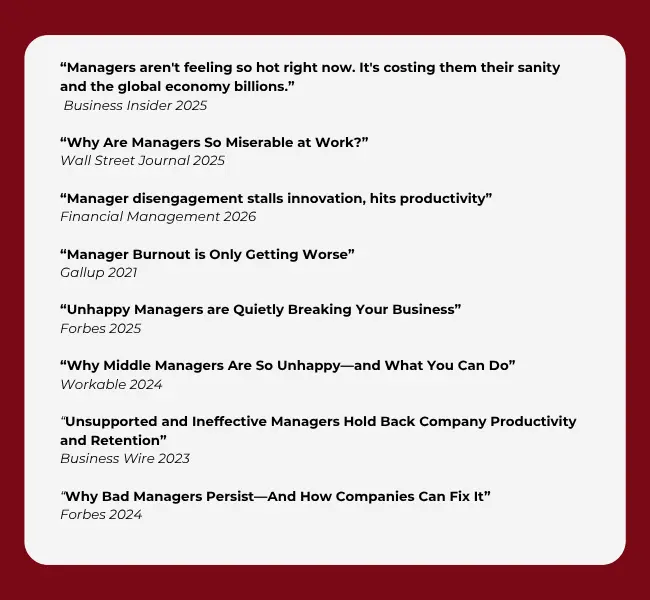
In addition, the current state of unsupported managers is incredibly costly—to organizations and the economy.
Gallup estimates that low engagement costs the global economy approximately $10 trillion in lost productivity every year—roughly 9% of GDP.
Simply put, when managers are overloaded, overwhelmed, and on their way to burnout, they’re not doing their best work.
But managers sit at the center of everything.
So, when managers struggle, then…
- Teams struggle to achieve cohesively
- Progress slows down for projects and initiatives
- Culture takes a hit
- Employee engagement drops
- Profitability and results decrease
And the impact extends far beyond one manager or team. It affects the productivity and performance of entire organizations.
Yet managers are being asked to lead the transformation of modern work while simultaneously trying to survive it.
They’re feeling intense pressure at the exact time they’re receiving LESS support than ever before.
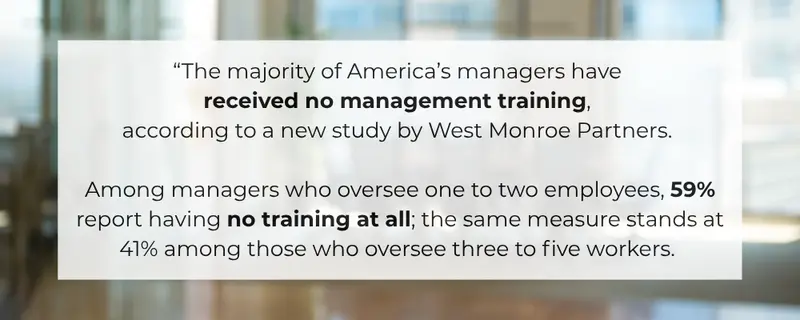
This is evidenced by Gallup’s State of the Global Workplace Report in 2025, which showed that only 44% of global managers received formal management training.
That means more than half of managers are managing people and projects WITHOUT formal preparation.
For a role that directly influences employee engagement, productivity, performance, retention, and revenue, that is both astonishing and disappointing.
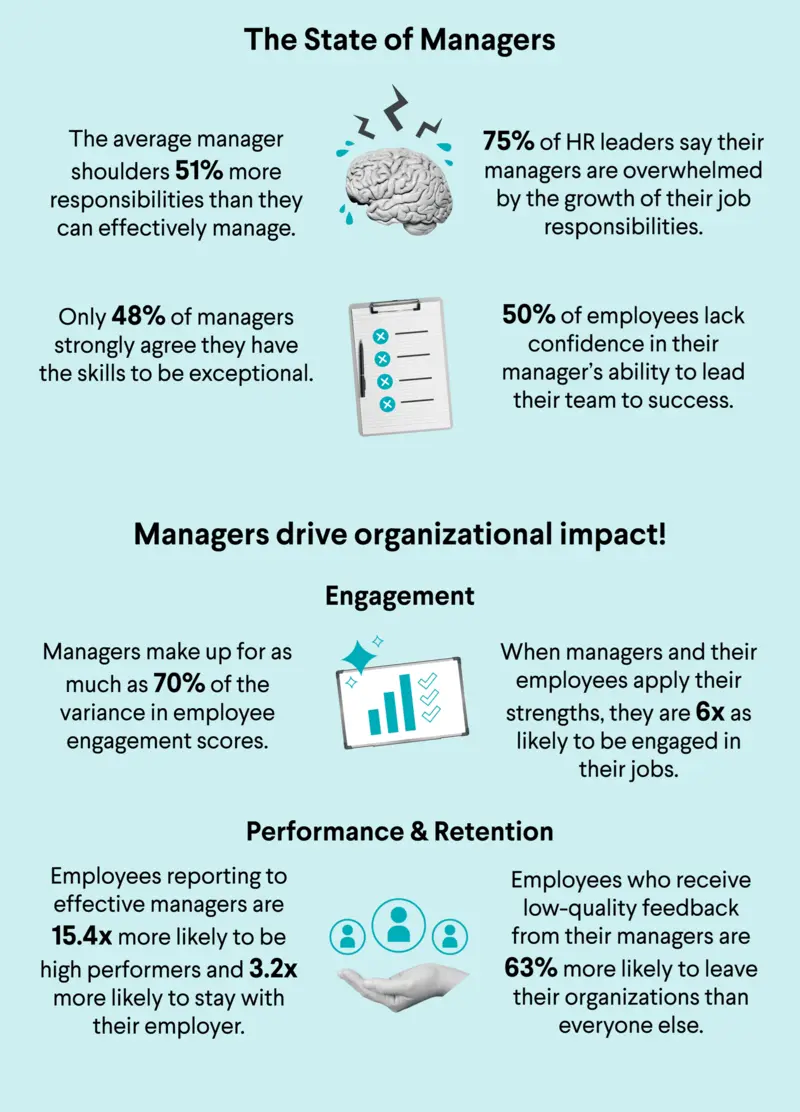
Managers are expected to lead and develop people, implement change, adopt new technologies, strengthen culture, produce results, and somehow still find time to do their own work.
They’re carrying responsibilities coming from every direction while being expected to meet deadlines, hit goals, and keep everyone else moving forward all at the same time.
It’s no wonder so many managers are struggling or burning out.
But here’s the interesting part…
Disengagement isn’t where the story begins (even though I started here.)
It’s where the story ends.
After working with leaders and managers for more than two decades, I’ve discovered that disengagement isn’t the real problem.
It’s the result of 2 much larger forces fundamentally reshaping the manager’s workday.
To understand what’s really happening, we need to step back and examine those 2 forces.
The first is work volume.
WORK VOLUME
Managers have a lot going on.
They’re feel the weight of the work coming DOWN from the top and the work coming UP from their team.
And that workload is heavy.
The C-Suite is consistently requesting more…
- Restructuring and staff changes
- Data and progress reporting
- New projects and initiatives
- Process and procedure changes
- Tech changes and AI adoption
Team members consistently require…
- Coaching and guidance
- Culture cohesion
- Conflict resolution
- Time with their managers
- Professional development
- Task and project management oversight
- Awards and recognition
- And more.
With so much going on, it’s easy to be worn out by the non-stop activity, requests, and deadlines.
To stay afloat and keep progress moving forward, many managers work long hours.
My client, Sandy, is one of them.
Sandy is in charge of a non-profit practice group in a $77M accounting firm of 300 employees in Massachusetts.
Sandy is a typical manager….
…a wife and mother to two teenage boys
…manager of a team of 16
…a shareholder in the company
…treasurer for 3 boards
…daughter of two aging parents, who own a family business… and since English is not their first language, Sandy gets pulled into legal and financial matters when they need her help.
She spends much of her time coaching her team, handling Q & A, problem solving, directing, and putting out fires while trying to accomplish her own work, which includes both client work and business development.
With everything moving so quickly, Sandy consistently felt like she was missing things.
When Sandy contacted me for the first time, she said, “I’m feeling very overwhelmed and it’s impacting my health and happiness.”
She added that she’s exhausted a lot of the time, saying that she’s 47, but feels 67 from how tired she is.
Sandy’s story is not unique.
And there’s plenty of research to illustrate…
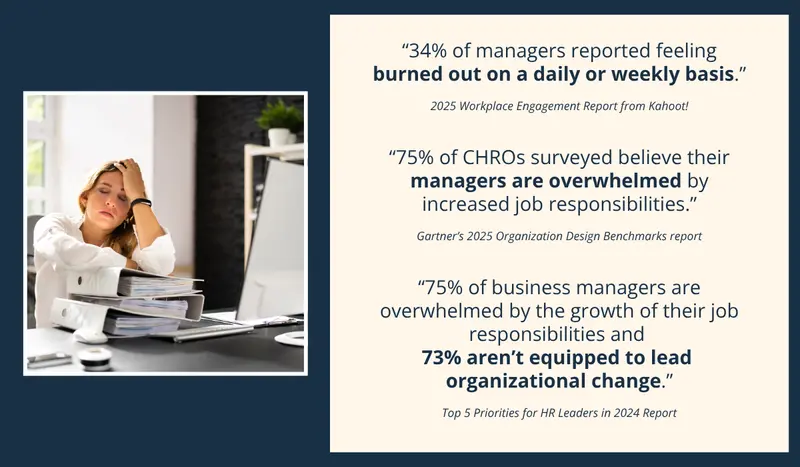
2025 Research from The Association for Talent Development (ATD), as reported in Inc.com, shared research about managers who said their organizations provided them with “little or no training” to prepare them for their first managerial role.
Sixty-three percent of managers surveyed said that being a manager was “much more difficult than they’d expected it to be” before starting the job.
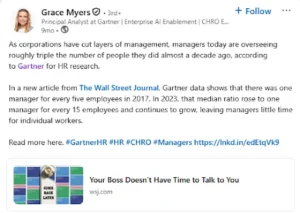
In addition, other Gartner data, cited by multiple publications, states that managers had been overseeing 3 times as many direct reports in 2023 as they did in 2017.
Grace Myers, Principal Analyst at Gartner, showed this last bit of data in one of her LinkedIn posts, with the number jumping from 5 employees in 2017 to 15 employees in 2023 for every manager, dramatically increasing the number of employees that many managers are expected to support.
So, work volume is rising, the number of people that managers are supposed to manage is rising, and yet…
Managers are not being given the training or support required to do their jobs, even as they’re asked to do more than ever before.
Meanwhile, when employees sense the “quiet cracking” and stress of their managers, it’s easy for them to be demotivated.
Sandy confirmed that her team can see her stress and frustration, but she doesn’t want them to see it. She wants to be a good role model for her people and show them that the path they’re on is a great career path.
Most managers likely feel the same way, but are having trouble concealing the challenges of everyday work.
When these challenges persist, it makes managers question their path forward and in the research I did for this article, I found an interesting twist on this topic.
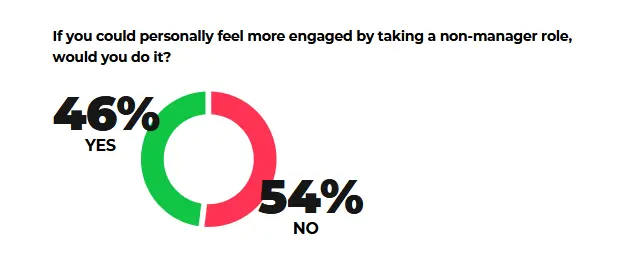
In the 2025 Workplace Engagement Report by Kahoot!, shared in an article published by Inc.com, nearly half of all the managers they surveyed (46%) said they would let go of their manager titles and roles if they could personally feel more engaged at work.
Have you ever felt that way?
It’s a shame that it’s come down to this trade-off, but this is the reality of the modern manager’s workday.
The volume of work that managers must handle is burying them.
But that’s only half of the story.
Remember, there are TWO forces that fuel disengagement.
The first is work volume. The second is about how to manage it.
It’s deciding what deserves your attention first.
You look at everything on your plate and think…
“Out of everything coming in, where do I begin?”
This is where work volume meets task ambiguity.
TASK AMBIGUITY
Managers are asked to be coaches, mentors, strategists, culture-builders, communicators, AI adopters, and project managers.
If that sounds like you, you’re likely drowning in a steady flow of responsibilities, requests, meetings, messages, and competing priorities—all of which seem important. Some are urgent.
Faced with an ever-expanding MOUNTAIN of work to do every day, you’re expected to choose between leading, coaching, managing change, putting out fires…
…and still somehow get your own work accomplished and hit the expected targets.
When talking with managers, I’m asked the same question over and over…
“Where do I even start?!”
But the challenge isn’t that managers don’t know what their job is.
It’s figuring out where to FOCUS.
If that sounds familiar, you may be wondering…
“What should I be working on right now?”
“Out of all the things I could do, what deserves my attention next?”
“I have so many competing priorities. Which one do I start with?”
This lack of clarity is where task ambiguity lives.
Being in a state of task ambiguity is wasteful of time, because workflows aren’t seamless. There are a lot of stops and starts throughout the day.
Email is a burden. Information is hard to find. Tasks are hard to track.
Task ambiguity makes it hard to keep up, much less get ahead.
Feeling accomplished is elusive, making you feel increasingly stuck.
But like most managers, I know you want to do a great job and make progress!
So you might start early in the day, work late into the night, and work weekends…
And still feel behind.
But working hard and going nowhere is defeating.
And when working like this day in and day out…
It raises stress, leads to burnout, and then ultimately…
Disengagement.
With less enthusiasm, the volume of work is even harder to manage. Task ambiguity persists.
And the cycle continues.
OPERATIONAL EXECUTION
The chaos of the modern workday has been caused by the chaos of how work is being managed.
You’re expected to perform at a high level, but probably weren’t taught how to manage the volume and velocity of modern work.
Even if you’ve received all kinds of leadership training and development in the past…
You may not have been offered the training you really needed to stay on top of your work.
As a matter of fact, research from the past has shown that many managers adapt their work style by simply mimicking a former boss, which is definitely not the answer.
This means that you may have been blamed for poor outcomes in the past while you were operating with a broken system or no system at all.
So, the problem isn’t you, the manager.
It’s the system you’re using. Or lack thereof.
This is what leads to the Great Productivity Gap™, which I explained in Issue #1 of The Efficiency Edge.
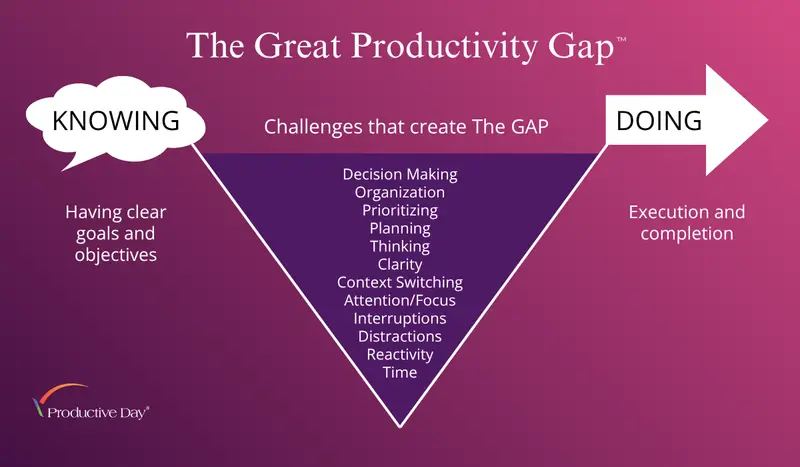
This is the gap between knowing what to do and actually being able to do it.
This is when a High Work Volume + Task Ambiguity = Slow Execution
So here’s the deal…
Operational Leadership determines where an organization is going.
Operational Execution determines whether it ever gets there.
Operational Execution is the missing piece from the workday picture.
Execution addresses the questions of…
How do I actually get my work done?
How can I manage competing priorities?
How do I make consistent progress confidently when work is coming from 15 different directions?
When you don’t have the answers to those questions and you don’t have the skills you need…
…every project and initiative undertaken will be seriously inhibited.
It’s going be a slog.
Have you ever felt that way when trying to move quickly and make progress?
If so, it’s because you simply don’t have the capacity, clarity, system, or support you need to execute quickly, effectively, and consistently every day.
You’ve been left to figure it out on your own.
And it’s NOT working.
Again, I wrote about this in greater depths in Issue #1: The 3 Forces That Have Radically Reshaped the Professional Workday, when I talked about the workload management crisis.
When you aren’t able to keep up with everything you need to do and have no idea where to start or what to do first or next, time is wasted.
When time is wasted, productivity takes a hit and so does progress.
And because managers touch all levels of business, the impact is felt everywhere.
And everyone will pay the price: you, your team, and your company.
To escape this cycle of doom, you might think you have to work harder or work longer hours. Perhaps be more disciplined or organized.
But that’s not so. You also don’t need more leadership skills, communication skills, or tech training.
And you certainly don’t need more apps, hacks, tools, tech, or AI.
What’s needed is a better way to manage the complexity of the modern workday.
This is possible by gaining workload management skills, which are the backbone of daily efficiency and productivity.
Workload management skills are necessary for tracking tasks, making decisions, managing email, managing information, prioritizing, planning, strategic thinking, and to keep momentum going.
Without these skills, execution is a BIG hurdle.
It’s impossible to clearly see WHAT needs to be done and WHEN, making progress and results slow to appear.
The combination of work volume + task ambiguity leads to challenges that EXHAUST managers.
And this fertile ground where disengagement grows.
WHAT YOU CAN DO IF YOU’RE A MODERN MANAGER
The solution always comes back to having a solid method for managing tasks.
Not more technology… a METHODOLOGY.
You need ONE complete system to manage your day if you want to be SUPER efficient and on top of your game.
A system that offers clarity, certainty, confidence, and control.
A structure you can lean on to execute daily—more easily, readily, and steadily.
When you have a complete system, everything flows from there.
Because the modern manager meltdown I not a people problem.
It’s a workload management problem.
Without a system, it’s easy to feel overwhelmed, because your work is fragmented. It’s everywhere.
Email
Calendar
Sticky notes
Notebooks
Legal pads
Voicemail
Texts
Slack
Teams
Hallway conversations
Meeting notes
Social media
In your head
and in so many other places.
So, choose ONE platform. Yes, you need technology, but just ONE platform will do. Build your task list there.
- Get rid of as many tools as you can (legal pads, planners, spiral notebooks, whiteboards, excel, word)
- Pull tasks away from their sources (email, voice mail, texts, meeting notes) and get them into the ONE platform you’ve chosen.
- Assign action dates (not due dates!) to each and every task.
- When tasks are on one platform, each with their own action dates (we call them Do Dates in Taskology), you can easily compare them and prioritize.
- Group your task list by action date and compress/hide all future days except today (this helps reduce overwhelm and increase focus.)
And P.S. don’t expect AI to do all of this for you and do it well.
This is a much bigger topic for another Efficiency Edge newsletter, but I’ll just say this for now…
Please understand that if AI is NOT connected to everything you have…
…all of your apps and tools, plus what’s on your desk, what’s in your head, what just happened a few minutes ago, what you just discussed in your meeting, it will NOT be able to give you a complete picture of what’s on your plate.
And therefore, it will NOT be able to make accurate assessments of your work, make good decisions, or properly advise you about the BEST use of your time and what to do right now.
AI can do tactical reasoning. But it cannot touch human judgement.
And again, it’s NOT connected to everything. Maybe someday it’ll be able to do all of that, but it simply cannot be done at this moment in time.
So, wrapping up… let me know how you’re feeling today about what you have on your plate right now.
Do you feel more burdened by the VOLUME of your work right now or the task AMBIGUITY?
Which one is your biggest challenge at the moment: how much there is to do or how to do it?
Hit Reply on this email and let me know. And if BOTH is your answer, let me know that, too!
That’s all for now…
Until next time…
Remember to make the most of your minutes.
Protect time for what matters.
And make memories you’ll cherish for years to come.
Greater productivity doesn’t mean packing MORE work into your workday.
It’s about getting the right work accomplished from start to finish, faster and easier, during your workday so you can gain more time and freedom, and enjoy more life.
To your productivity and success,
Leslie
List of links:
The Hidden Cost of Disengagement: https://abhijitbhaduri.com/global-trends-insights/the-hidden-cost-of-disengagement-what-gallups-2025-global-report-means-for-you/
Who’s to Blame for Organizational Chaos: https://blog.ttisi.com/who-is-to-blame-for-organizational-chaos
The State of Managers: https://www.lifelabslearning.com/blog/what-types-of-training-for-managers
LinkedIn Post: https://www.linkedin.com/posts/grace-monica-myers_your-boss-doesnt-have-time-to-talk-to-you-activity-7368742407288438785-B6uX/
West Monroe Partners: https://www.hrdive.com/news/managers-say-they-lack-training-and-44-feel-overwhelmed-at-work/520396/
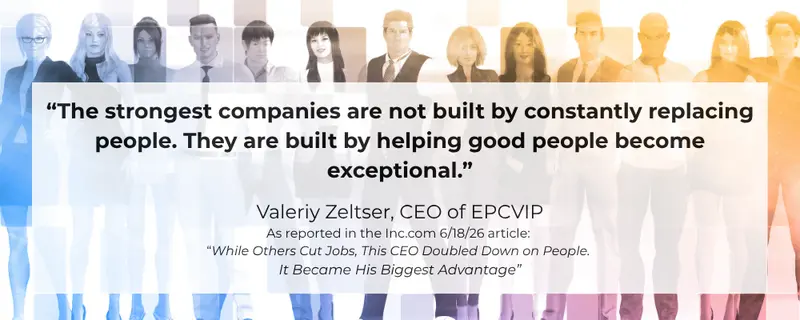
The strongest companies are not built…:
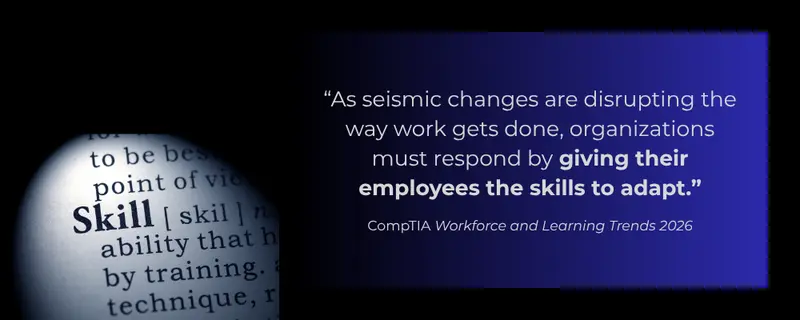
Skill: https://www.comptia.org/en-us/resources/research/workforce-and-learning-trends-2026