




If your workday feels chaotic, fragmented, and harder to manage than ever, you’re not imagining things.
The modern workday has fundamentally changed.
A paradigm shift has taken place and what used to be our old, familiar workday is no more.
Not long ago, work followed a predictable pattern. Each day had a beginning, a middle, and an end.
Most likely, you…
…left home and arrived at an office work to in a specific space every day.
…worked through the morning, had lunch, worked through the afternoon.
…wrapped up the day by turning off the light in your office, closing the door, and heading home.
Remember those days?
Your work lived at the office and you lived at home.
In the past 5 years, that model has disappeared.
Now, the workday has become a continuous stream of messages, meetings, and notifications.
Our days are filled with rings, dings, and pings to notify us of tasks, updates, and email.
Distractions constantly tug at our attention and interruptions break our focus.
We go in one direction and then mere moments later, we’re pulled in another.
Digital interruptions start earlier, end later, and rarely, if ever, stop.
Most professionals describe feeling busy all day, but can’t put their finger on what they actually accomplished.
You may have thought in recent times,
“My work is never done. I always feel behind.”
“It’s harder than ever to keep up. My work keeps showing up in different places.”
“Work feels heavier than it used to, even though I’ve got more tools than ever.”
These thoughts aren’t signs of incompetence, inability, or a lack of discipline.
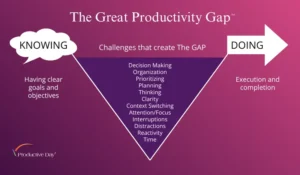
They’re signals of a much larger shift happening in the workday, creating what I call…
The Great Productivity Gap™.
Let me explain what I mean by this.
The Great Productivity Gap™ is the ever-widening space between what we need to do and our ability to do it consistently every day.
We’re now entering a new era of work defined by three converging forces that have fundamentally reshaped how we work.
These forces didn’t arrive all at once. They developed gradually over many decades, as technology, communication, and expectations transformed how work was done.
What began as small shifts in the 1970s, ‘80s and ‘90s eventually accelerated into three powerful megatrends.
Individually, each of these trends is significant. But together, they’re creating a work environment that is like none other than we’ve ever experienced in the past.
The first of these three forces is…
Force #1: The Collapse of the Structured Workday
For decades, the workday has had a recognizable structure.
I remember working right out of college starting in 1990 when I and everyone else arrived at work at 8:00 am.
Everyone in the office was dressed up in suits and ties, and dresses and skirts. Casual day was a rare gift!
Most everyone had an office and if not, you had a dedicated cubicle in which to work.
There were clear boundaries between focused work and collaboration within meetings.
When meetings were scheduled, you got up from your chair and left your workspace to go to a meeting room or board room, or someone else’s office. (Do you remember what that was like?)
When you had new work to do, it came generally from 5 places:
- The inbox on your desk, where someone could put new papers, files, or the day’s mail
- The fax machine
- A phone call
- A meeting
- An in-office conversation
Lunch times were spent in a lunch room or elsewhere and breaks were short, but expected.
You had a phone, but you could leave it at the office, because it was an office phone. Cell phones weren’t common and there was no texting.
Even when work was demanding, there was still a general rhythm to the day and more importantly, an end.
And when 4:30 or 5:00 o’clock arrived, you turned off the light, closed the door, and left the office behind.
Today, that structure is gone.
The modern workday is now amorphous. There is no solid shape to it. And it is no longer confined.
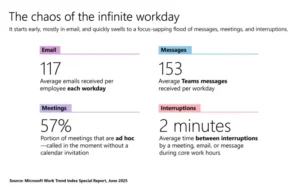
This is evidenced by the identification of “The Infinite Workday” by Microsoft in their 2025 Work Trend Index Annual Report.
This new term describes the unstructured, unpredictable, and boundary-less workday we have today.
To start with, the space dedicated to work isn’t specific anymore. Some people work at an established office location. Some people work at home. Many do both.
The time dedicated to work has lost its structure, too. In their report, Microsoft shares evidence of this…
- 40% of employees get online at 6 am to review email in the Inbox and try to plan their day.
- By 10 pm, nearly 30% of workers are back in their Inboxes to catch up or keep up.
- Nearly 20% of workers are in their Inboxes before noon on Saturdays and Sundays, too.
The workday no longer has guard rails. It’s wide-open and never-ending.
The “portable” office enables this trend since we can carry laptops and work papers to and from home.
But what makes the workday even more inescapable is the cell phone, which is always with us, by our side.
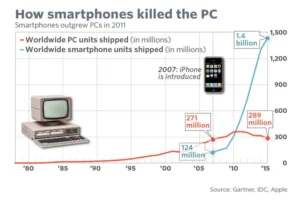
Add to this the multitude of collaboration tools and messaging platforms contained by our laptops and cell phones and our time and focus are perforated by notifications, messages, and requests.
This new, amorphous workday is not just longer and more fragmented. It’s more easily filled up with responsibilities and commitments.
Virtual meetings fill up more of the white space on our calendars, because they’re easy to attend.
Work no longer arrives in small bits from phone calls, mail, faxes, or meetings. It rolls in continuously because of technology.
So, instead of moving linearly and proactively through a clear sequence of tasks, most professionals now spend their day reacting.
Jumping from email to IMs to phone calls to a to-do list to a text to a document to a live conversation, attempting to keep up with a flow that never slows down.
The result is a workday that feels less like a place where work gets done and more like a raging river that carries us from morning to evening, and at the end of the day. And we STILL have work left to do.
With a collapse of the structured workday, balance is gone and the plan for getting things done is unstable.
It’s much harder to focus, protect time, and make meaningful progress. At most times, it’s even a challenge to know where to start.
Enter the next force—AI—which is now omnipresent and has promised to make us more efficient and productive.
But is it living up to that promise?
Force #2: The AI-Productivity Paradox
AI is now ubiquitous. Artificial Intelligence is in the headlines everywhere we turn.
It has promised to make our work easier and eliminate repetitive tasks to free up time for higher-value work.
As this illustration from Menlo Ventures shows, every generation has adopted AI at some level.
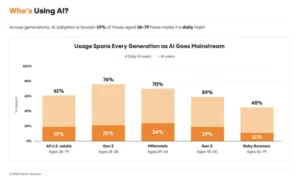
In theory, this should make us all more productive.
In practice, something very different is happening.
According to an ongoing study by researchers Aruna Ranganathan and Xingqi Maggie Ye, and published in Harvard Business Review, AI tools aren’t reducing the work, but instead are intensifying it.
As summarized in the HBR article:
“In the study, employees worked at a faster pace, took on a broader scope of tasks, and extended work into more hours of the day, often without being asked to do so. That may sound like a win, but it’s not quite so simple. These changes can be unsustainable, leading to workload creep, cognitive fatigue, burnout, and weakened decision-making. The productivity surge enjoyed at the beginning can give way to lower quality work, turnover, and other problems.”
In other words, AI has promised to change the way we work. But that promise comes at a huge cost.
The advent of AI means we have new tools to learn and that learning costs time.
This is a time demand on TOP of what was already a super-packed, rushed workday where you’re feeling stretched, stressed, and sensitive to the passing of time.
Add to this the fact that AI is changing SO fast that every WEEK there is a new development.
Once you learn a new AI tool, it could be obsolete within MONTHS.
This means that there’s ALWAYS something new to learn.
It’s becoming a full-time job just to learn the AI tools that are supposed to make us more productive.
In many cases, MORE time is spent learning how to use the AI tools than actually doing the work that needs to be done.
In addition, while AI is accelerating the ability to accomplish certain tasks, it can also cause more work on the back-end, which can cost more time to review and fix it.
Using AI is also dramatically increasing the volume of work that must be addressed.
Content is generated faster. Communication happens more frequently. Expectations rise for keeping up.
The result? AI isn’t reducing the work.
It’s amplifying the volume, scope, and pace of work, which can easily become unsustainable on an ongoing basis.
This makes deadlines harder to meet, promises harder to keep, and expectations harder to reach.
The AI that is supposed to increase efficiency and productivity is slowing down progress because it’s increasing the complexity, communication, and cognitive load around the work that needs to be done.
This creates what many organizations are beginning to recognize and experience as the AI-Productivity Paradox.
Does any of that sound familiar?
Whether leaders and workers are skeptical about AI or hopeful about it, everyone agrees at this moment that it’s unstable, unpredictable, yet demanding.
The continuous learning curve required to keep up is impossible to keep up with, putting the simultaneous goals of keeping up with new AI developments AND hitting your weekly, monthly, and quarterly targets at odds with one another, which has created the 3rd Force…
Force #3: The Workload Management Crisis
The third force stems from years of an ongoing imbalance between the amount of work to be done and time in which to do it.
This imbalance has slowly grown into a crisis in much the same way a frog panics in a bucket of slowly, but increasingly boiling water.
This imbalance causes more stress and burnout every year, making work even harder to accomplish.
Here’s a quick overview of the progression in quick highlights, starting with this chart showing how society has evolved with technology as measured by output per hour since 1900…
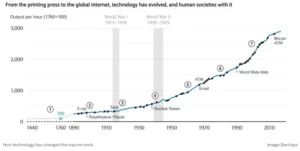
1974: “Burnout” was a term identified in 1974 by Psychologist Herbert Freudenberger as a workday phenomenon.
1990s: Fast-forward to the 1990s on into the 2000s and technology increased at rapid speeds and, along with corporate restructuring, downsizing and increasing workloads, stress and burnout started to rise.
2015: Deloitte had identified the “overwhelmed employee” as an emerging trend in their “2014 Global Human Capital Trends” report.
2020: The Pandemic of 2020-2021 heightened workplace stress as the workplace moved to homes around the world, blurring the lines between work and home commitments, blending the technology used for both, and the time dedicated to each.
2025: Research showed that 66% – 79% of U.S. employees experienced burnout, making it a critical metric for organizational health and retention.
Thus our arrival to a new level: The Workload Management Crisis.
So, here’s the deal…
The speed and complexity of work today make it incredibly hard to keep up with the ever-expanding flow of tasks, information, requests, messages, and decisions that need to be addressed.
Professionals are burning out, because the way they used to work in the past isn’t working anymore.
They improvise and create routines that sustain them for a while—maybe even a long while—but today, those methods are falling short in helping them reach the targets they want to reach and that they’re expected to reach.
Professionals rely on multiple to-do lists, sticky notes, email flags, their memory, and a combination of tools and tech that were never designed to work together.
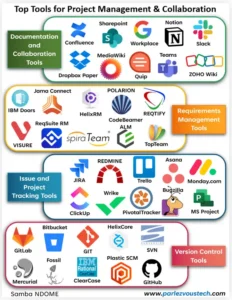
As an example, there are HUNDREDS of task and project management apps on the market today. And they’re only growing in number. The choices are dizzying.
This ReviewStartup.com illustration only shows a fraction of them…
As workloads increase and become more fragmented, these shaky methods begin to break down.
Important tasks slip through the cracks. Priorities compete for attention. People spend more time trying to track down where work is coming from, and trying to manage it and prioritize it, than actually getting the work done.
Many don’t realize the difference between managing the work and actually getting the work accomplished.
Thus, we have the growing burden of “the work behind the work.”
This kind of work includes communicating about work, searching for information to do the work, switching between apps, managing shifting priorities, and following up on the status of work.
It’s what you do throughout the day, but isn’t the actual skilled work you were hired to do
Let me explain…
There are actually two missions in your workday. Both need time. Although, not equal amounts of time.
Time must be spent DOING your work and time must be spent managing HOW you work, but you want to spend as little time as possible on HOW you’re working.
There should actually be a disproportionate amount of time spent DOING your work as compared to the time spent managing it.
DOING work is about using your expertise. It’s about doing what you do best… what you LOVE to do—unfettered, unencumbered, and uninterrupted. You accomplish REAL work when your time is spent doing the work you love.
HOW you work is like the operating system that should be running quietly and smoothly in the background of your day, but for many professionals, it’s not working that way. And time is lost because of it. Time you could be using doing meaningful work.
The time you dedicate to “the work behind the work” is further complicated by the many tools and apps that are used, which can steal more time from actually getting work done and slow you down.
How you work is about…
…how you protect time to work on your most important tasks and projects
…how you prioritize tasks
…how you plan action steps
…how you find information
…how you manage email
…how you make decisions
…and more.
If HOW you work feels like you’re slogging through molasses, then how you’re working isn’t working.
The processes used to manage work is STEALING time from the part of the day when work could actually be accomplished.
The imbalance caused by spending too much time on HOW work is managed versus getting the work done is creating a workplace in which we now have “quiet quitting,” “quiet cracking,” “culture rot,” “boreout,” “task masking,” “gray work,” “ghostworking,” and “productivity theater.”
In other words, a Workload Management Crisis.
When Three Major Forces Converge
Each of these trends—The Collapse of the Structured Workday, The AI-Productivity Paradox, and The Workload Management Crisis—would be challenging on its own.
Together, they create a perfect storm.
It’s one that professionals are increasingly having a hard time weathering.
- They start the day with good intentions, but quickly find themselves pulled into reactive work.
- They end the day deflated from not accomplishing what they set out to do.
- By the next morning, they’re already stressed out and de-motivated as they start the day.
Professionals are working longer hours, but still feel behind.
They juggle dozens of responsibilities while carrying a constant low-level anxiety that something important might be missed.
To keep up, they’re looking for new methods as if they were life boats, life jackets, and life rafts.
Many are clinging to whatever they can find to keep them afloat.
Most don’t find what they’re looking for and continue to tread water until they do.
And it’s exhausting, isn’t it?
Most frustrating of all, many people assume the problem is personal—that they need better discipline, stronger focus, or more willpower—when in reality, the problem is structural.
And that’s not your fault.
Why This Matters Now and What It Means for You
The modern workday isn’t just evolving. It’s accelerating.
Organizations are moving faster. Technology is advancing rapidly. Expectations for responsiveness, collaboration, and output continue to grow.
Ignoring these forces won’t make them disappear.
Understanding them, however, is the first step toward navigating this new kind of workday more effectively.
Because when three forces like these converge, they don’t just reshape the way we work.
They reshape our lives as well.
Closing The Great Productivity Gap™ requires a fundamentally different approach to managing work.
And the professionals and organizations that recognize this shift now will be the ones best positioned to adapt.
So the big question is…
What do we do about all of this?
Well, that’s the topic of the next Efficiency Edge.
You’ll receive Issue #2 of The Efficiency Edge next month, but you’ll hear from me again before then. We’re cooking up some new product and program offerings so you can take control of your workday in do-able, bite-sized steps. More on all of that coming soon…
In the meantime, I would absolutely love to hear from you.
Which of these 3 forces is showing up for you the most right now?
I read and respond to every email. And hearing your thoughts will help me learn more about the topics I can address for you in the future.
That’s all for now.
Until next time…
Remember to make the most of your minutes.
Protect time for what matters.
And make memories you’ll cherish.
Greater productivity doesn’t mean packing MORE work into your workday.
It’s about getting work done from start to finish faster and easier so you can gain more time to enjoy life.
Leslie
P.S. Again, if the topic from today landed for you, send me an email and let me know which of those 3 forces is the one you’re feeling the most!
Book Your Call: https://productiveday.com/talk/
Get Started Today: https://productiveday.com/taskology/