



Productive Day just celebrated 23 years in business (August 2026) and over the years, I’ve seen quite a few changes in how we work.
In the most recent Efficiency Edgenewsletters, I’ve highlighted more recent trends in workplace productivity and explained the bigger picture behind what’s happening in the modern workday.
I talked about things like the Collapse of the Structured Workday, the AI-Productivity Paradox, and the Workload management Crisis, and how they’ve collided to create the Great Productivity Gap™.
I walked you through how we got here, why so many of the traditional solutions fall short, and why I believe in a fundamentally different approach to making real progress at work.
The bottom line is this:
No matter how many changes have occurred in recent decades and how much technology has been introduced, and no matter how alluring AI can be…
One thing will always remain the same: using a SYSTEM will support your success at work.
The flagship system of Productive Day continues to deliver the same kinds of great results for clients today as it did twenty years ago. And it will continue to deliver those results for the next 20+ years.
And because that’s true, I want to give you the #1 strategy of the system that will help you take control of your workday now so you can finish 2026 strong and jump right into 2027 quickly with more ease, efficiency, and effectiveness.
More specifically, I want to address how you’re managing things to do—projects, tasks, follow-ups, reminders, and action steps.
Today, you might be using a few tools and some habits and routines that have been part of your workday since the early part of your career.
You may feel like these have been serving you well for a long time. Or maybe you’ve recently noticed that some of those tools or routines have not been holding up as well as they used to.
Let’s get into the details about to-do lists. More specifically, how to think about your to-do lists, what to avoid, what to focus on, and what to do now if you truly want to take hold of the steering wheel of your workday to get greater progress and results.
Your daily To-Do List is costing you.
Experts and gurus everywhere have been sharing this bad advice for decades:
“Use the first 30 minutes of your day to reflect and create a to-do list for the day.”
It’s very common, but very unproductive—even damaging—advice.
Similar unproductive advice recommends 10-20 minutes of weekly planning on top of this, perhaps on a Friday or on a Monday—or worse, on a Sunday—for the upcoming week.
All of this advice is wasteful of your time.
Why? Because you shouldn’t have to write or rewrite, or recreate a to-do list every day AT ALL.
Even though today’s psychology says “If you still make handwritten to do lists, …you are practicing mental clarity and self trust, and you handle busy days with steadier calm,” I will challenge that every time.
“Steadier calm?” Really? I’m not buying into that perspective at all. Here’s why…
The stress of unmanageable email and the endless volume of tasks everyone gets—coming in from more than a dozen different places—with no way to easily prioritize—quickly ZAPS that “calm” like a lightning bolt.
Here’s why daily planning is so costly…
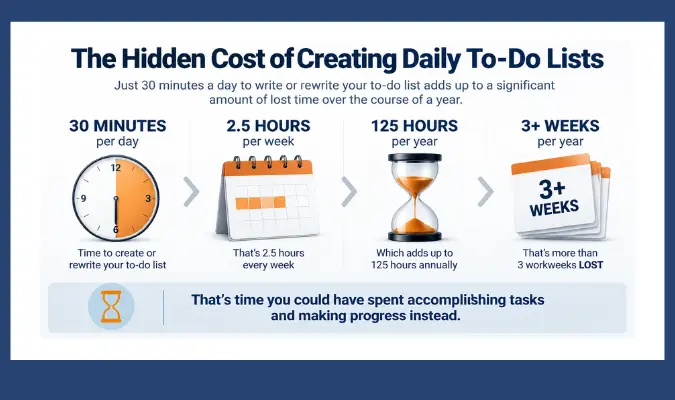
Spending 30 minutes every day on daily planning equates to 2 ½ hours every week, 125 hours annually, and more than 3 WEEKS per year. LOST.
This is time you could have spent accomplishing tasks and making progress instead of writing, rewriting, re-typing, or consolidating to-do lists.
Meanwhile, when people say they’ve tried to put tasks into an app or type them into a digital task list, but end up hating it, it’s understandable. But not for the reason you might think.
Digital to-do lists work, of course, but they DON’T work well for most people because they don’t have a method or a process to follow.
Accounting for tasks is a lot like accounting for money.
Imagine the process your Accounts Payable department uses to manage payments for invoices they receive daily.
In the early part of the 20th century, this process was paper-based. Between the 1960s and 1980s, Electronic Data Interchange (EDI) was developed, which made a digital approach more available.
In the 1990s, Enterprise Resource Planning (ERP) emerged and allowed for a complete digital centralization of the accounts payable process.
In the early days of this process, it was on paper and it was a challenge to know what to pay and when. Every invoice received was either logged by hand or typed up on a list. Once logged, the invoices were added to a pile on the desk or into a file somewhere until they were paid.
And every day, the person in charge of Accounts Payable would look down the list or flip through the pile or file of invoices to see what was due or what they could or should pay.
With modernization, however, allinvoices are entered into ONE accounts payable system and a clear plan exists for making payments.
Now let’s talk about how tasks are accounted for.
Today, many professionals put their to-do lists on paper in things like legal pads or notebooks, and then they review it multiple times a day.
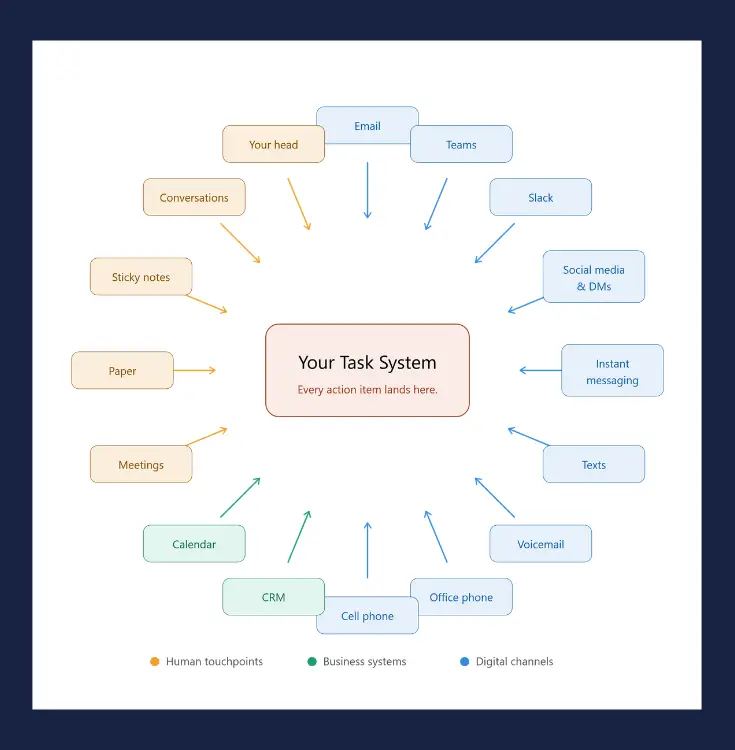
They also repeatedly review the papers and files on their desk, emails in the Inbox, voice mails, texts, and a dozen other places where tasks originate. Remember the more than 12 different sources of tasks I always talk about?
To accurately account for all tasks and manage them well, they should be entered into a single digital, central SYSTEM where you can add all pertinent details and give each task a target date of action. This makes documentation a breeze, prioritizing easy, and planning more accurate.
From there, a plan automatically emerges… and nothing is ever missed, lost, or forgotten.
Why? …because when everytask is added to a system with a target date of action, and that system allows for both sorting AND grouping by Action Date, you’ll not only have a complete plan, but you can easily avoid the overwhelm of trying to do too much in one day.
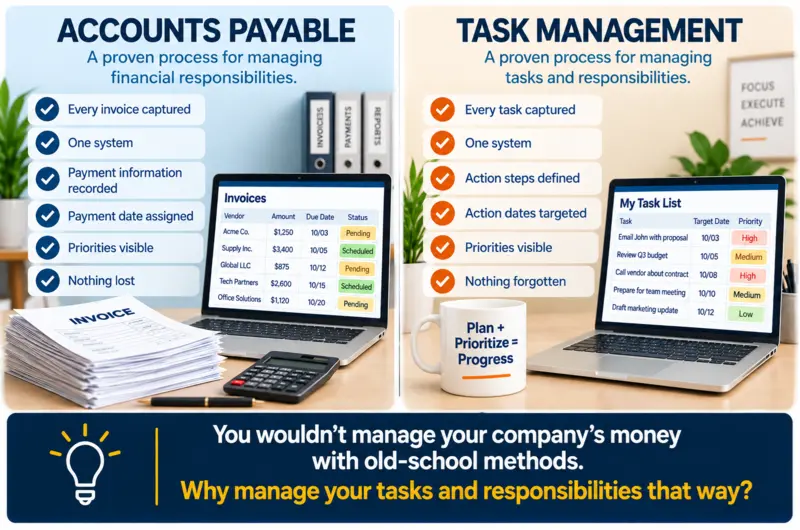
You’ll be able to stay on top of your tasks using one system that reflects back to you what you said you wanted to do today and every day forward. Even when priorities shift.
And we all know, priorities shift moment to moment—like sand in the wind. When that happens, you’ve got to be able to pivot, but without missing, losing, or forgetting anything.
The question I pose to you today is this: You wouldn’t manage your company’s money with old-school methods. Why manage your tasks and responsibilities that way?
Here’s the next question… and too many professionals are NOT asking this one:
What’s the definition of a “task?”
What happens when a task is not a task.
In Taskology®, a task is defined clearly so there’s no question about what to do, how to do it, why you’re doing it, how long it will take (approximately), and when to do it.
These days, a “task” is not a word every guru defines. But we do at Productive Day, because it’s the key to making progress. And progress results from managing tasks, not projects.
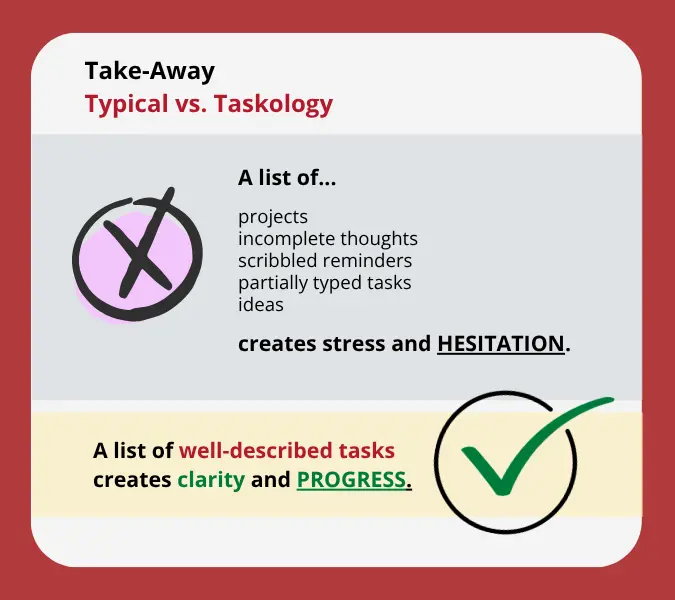
The problem with today’s to-do lists is that they reflect a total mix of things to do, both big and small, and everything in between: projects, multi-step tasks, to-dos, reminders, ideas, and more.
But how you state and describe a task is critical. It will make or break your daily efficiency.
When you’re NOT stating and describing REAL tasks, it makes it hard to get everything done on your to-do list.
You’ll hesitate and procrastinate on the things that are too big.
You’ll encounter delays on things you want to do sooner than later, but don’t know where or how to start.
And you’ll totally focus first on what you can cross out. (And by the way, those are likely your true tasks.)
The tasks I teach my clients how to create have 5 essential elements. The most important driver is the one that reflects how long a task will take: 30 seconds to 30 minutes long. There are exceptions, of course, but it’s important to learn how to identify a very smallfirst or next action step.
The second most important element of a task is that it starts with a verb, which incites action and tells you that you’ve already thought through exactly what you’re going to do and the action step you’re going to take. (And btw, if you want ALL 5 elements of a task, you can get my Fast-Action Formula for Tasks today. It’s like a mini crash course for Taskology® Task Management that includes a short, 7-day video series, a helpful workbook, and a PDF of the Formula.)
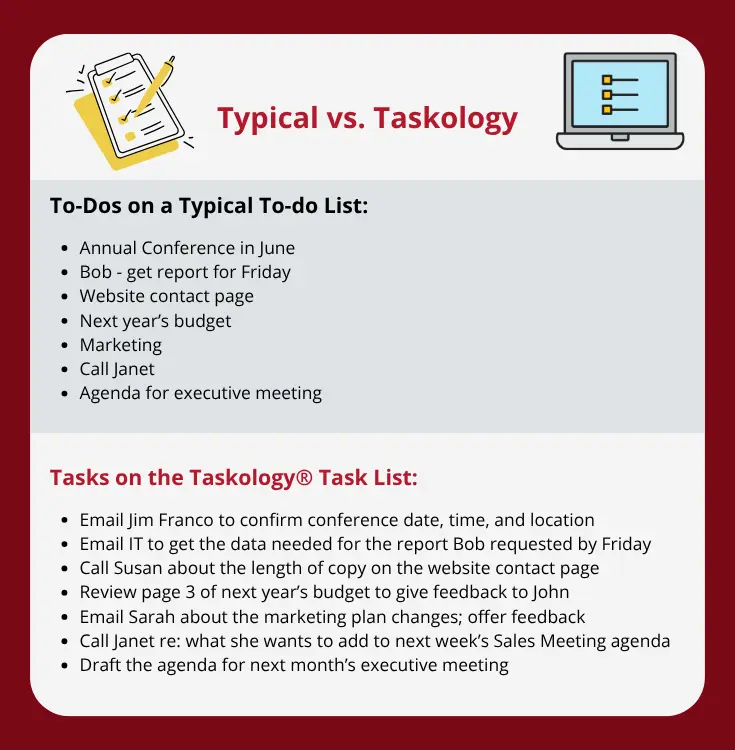
The take-away here is that tasks on a typical To-Do List will only slow your progress and increase stress from the old-school way of doing things.
Instead, with a list of well-described tasks, you’ll gain more time… get more clarity, confidence, and control… and make incredible progress, because you’ll have everything you need to know and you can dive right into action.
When your To-Do List is “incomplete,” you’re incapable of doing your best work.
When you use to-do lists, no matter where they are, they’re incomplete. I guarantee it.
How do I know this?
Because your to-do list, whether it’s on paper or in an app, it’s most likely missing all kinds of tasks that are still sitting at their source: in email, on texts, in your voice mail, on meeting notes, in social media. Am I right?
If your to-do list is incomplete, then getting things done will be harder to do, and this is holding you back from doing your best.
Here’s something extremely important to understand…
If you’re not adding tasks to a single SYSTEM all throughout the day—from email, voice mail, texts, social media, meetings, etc—you are, by default, forcing yourself to continue to use paper for tracking to-dos and it WILL be an ineffective, partial list no matter what tool you’re using.
This automatically means you’ll have a hard time keeping tasks in your vision.
And if tasks are not in your vision, it’s an open-door invitation for tasks to be missed or forgotten.
If tasks are missing from your vision, you can’t compare them and prioritize or plan correctly.
And then it’s impossible to accomplish what you can’t see.
So, instead, be sure to get ALL of your tasks into ONE digital platform so you can have an easier, less stressful, more efficient workday with an air-tight system to manage your tasks.
ALL of them. No ifs, ands, or buts.
Today is NOT the only day you should be planning for.
One of the biggest misunderstandings about a to-do list captured anywhere is that the list is only supposed to be reflective of what you want to do today.
It’s the logical conclusion to the bad advice I mentioned earlier: Use the first 30 minutes of the day to plan for the day.
That leads you to believe that your To-Do List is ONLY about what you want to do today.
But here’s the deal: The daily To-Do List is dead.
In its place should be a SYSTEM for managing tasks.
If you want to be on top of your work and on top of your game, you’ll want a system for ALL tasks and responsibilities no matter where they came from or when you plan to take action. All of them… outlined for weeks and months ahead.
This goes back to the similarities between a task system and an accounts payable system.
A daily To-Do list is like the old approach to AP in that it’s only outlining the things to do today or just the invoices to pay today, and then you don’t have a complete picture or a complete plan.
Working with a partial To-Do List leaves you with BIG gaps in your plan, leading to BIG gaps in your vision, your progress, and your results. And those BIG gaps are swallowing up all of the things you’re missing, losing, and forgetting.
And just one missed task causes a series of reactive steps that will cost you in time, productivity, and progress.
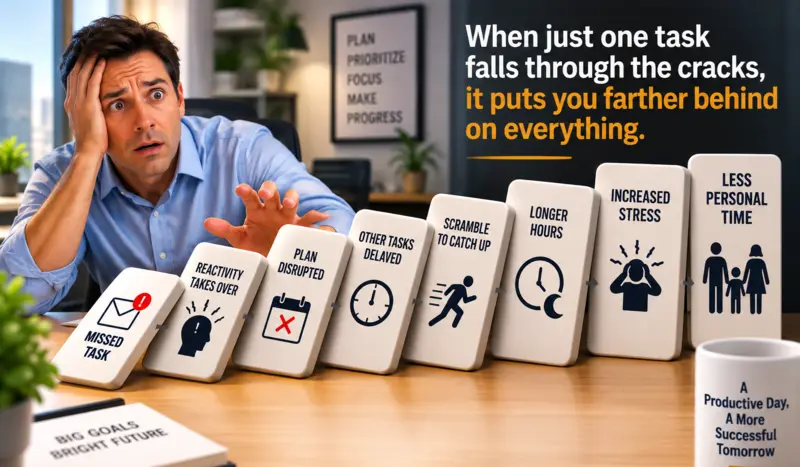
The damage of the domino effect.
In your workday, when your to-do list isn’t in any kind of order, next action steps aren’t well-defined, and priorities aren’t clear, your visibility and awareness will be WAY down.
Working with only a partial to-do list means you’re flying blind. Or at least partially blind.
You’ll move forward more slowly and second-guess yourself frequently.
You won’t be certain you’re prioritizing well or confident you’re taking action on the right tasks at the right times.
This lack of certainty and confidence will keep you in slow motion, increasing stress, and putting progress in low gear.
Then, when an important task or priority is missed or forgotten, reactivity takes off like a rocket.
Consider what that does to your day and the scramble it creates after you remember something you were supposed to do—or worse, someone elsebrings it to your attention.
It’s just like dominoes… once the first domino falls, it causes a cascade of other dominoes to fall as well.
You put your original plan aside so you can catch up on what was missed, and from there you fall farther and farther behind. It’s a cycle that keeps you stuck.
So many professionals are caught in this exact cycle. You may be one of them.
But the good news is that you can escape.
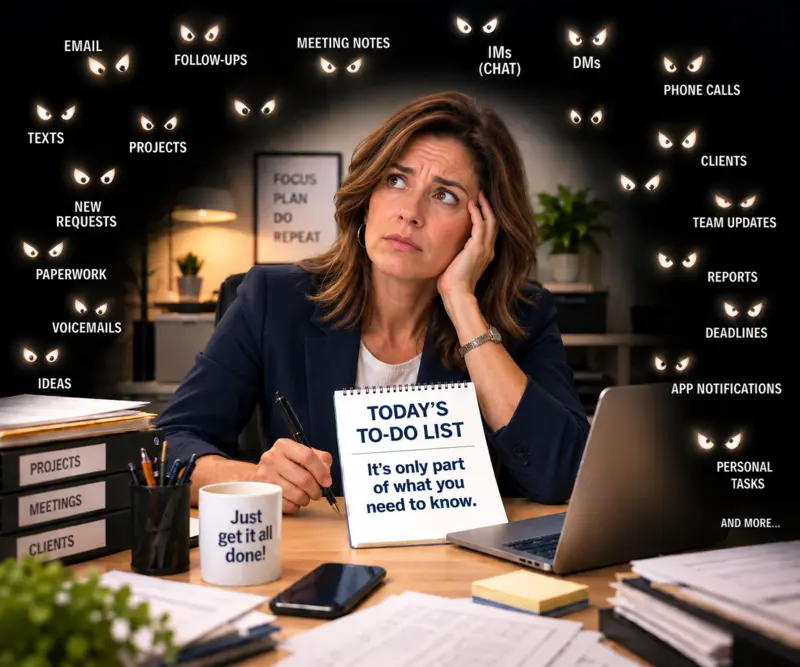
One more reason “once a day” is a scary play…
“Daily planning” is a big risk…
It highlights a task management process that is NOT ongoing or continuous.
But it should be.
When “task planning” only happens ONCE in the morning when you “regroup” or “catch up” from the day before…
You’re stuck in time. You’re focused only on a few tasks, yet tasks are flowing in continuously. The workday is constantly changing and priorities are shifting all the time.
This is when I hear, “Leslie, what do I do when my day changes and priorities shift, and I can’t get to my original plan for the day?”
The answer is, “You have to have a plan that includes ALL tasks and makes it easy to prioritize with precision, pivot with accuracy, and do it all without missing anything.”
Continuous prioritizing and planning are so necessary to keep up with today’s fast-moving pace. With tasks and emails that are rolling in all the time, you don’t want to miss anything, and you have to make sure you’re planning well.
If new tasks appear and one of them is FAR more important than what you had planned to do today, you’ll want a plan that allows you to shift gears with clarity and confidence, and while still keeping track of everything. You should be able to pivot, but without added worry or stress.
You’ll want a plan that allows you to incorporate new tasks as they appear so you can check to see if you’re STILL on the right track.
When you can gain (and keep) awareness of new tasks coming in, you get to decide if your plan is still right.
If you lose that clarity and the power to prioritize, you’re left clinging to a plan that is no longer accurate for most of the day.
But there’s good news: it’s easy to keep up with tasks when your approach is digital and everything is in ONE place.
In a recent article from Forbes, the authors talked about redesigning workflows and getting a competitive advantage in today’s workplace.
They said gaining a competitive advantage, “…won’t come from adding more technology. It will come from removing friction and creating intelligent employee experiences that help people move faster, make better decisions and execute with confidence.”
I wholeheartedly agree.
The best way to “move faster, make better decisions, and execute with confidence” is to use a continuous process for managing tasks—one that’s fluid, ongoing, reliable, and accurate.
There may be more than a dozen sources of tasks in your workday, yes…
but there should only be ONE place to manage them.
Imagine having all of your tasks in ONE system, giving you a clear, bird’s-eye view of your tasks—with 100% visibility and awareness all the time.
Imagine never having to write or rewrite your to-do lists ever again—and knowing exactly what deserves your attention now.
Imagine the clarity, confidence, and control you can gain, knowing that nothing has been missed or forgotten.
Best of all, you won’t have to spend up to 30 minutes every morning to review, regroup, catch up, or create a NEW plan that’s only good for ONE day.
Instead, you can regain those 2 ½ hours every week, 125 hours annually—more than 3 WEEKS per year!
The fastest way to make progress isn’t by writing another daily to-do list or by planning only ONE day at a time.
Progress will flow from using ONE reliable system that tells you everything you need to know and what to do next.
You’ll make progress every day in the time you’ve saved and you’ll feel so much better about what you’ve accomplished.
And when you end the day feeling satisfied, you’ll gain more personal time with peace of mind so you can be present with the people you love, do the things you love to do, and enjoy every minute you don’t have to spend thinking about work.
That’s all for today.
Until next time…
Remember to make the most of your minutes.
Protect time for what matters.
And make memories you’ll cherish.
Greater productivity doesn’t mean you have to work harder or longer.
It’s about how well you’re working and how efficient and effective you are with your time.
It’s time to get work done more easily and efficiently, so you can reach finish lines faster and have more time to enjoy life.
Leslie
P.S. To truly take control of your tasks and responsibilities, grab my Fast-Action Formula for Tasks. It’s only $149. It’ll give you everything you need to know to get your new Task List going with a short, 7-day video series and a helpful workbook. Check it out today.